

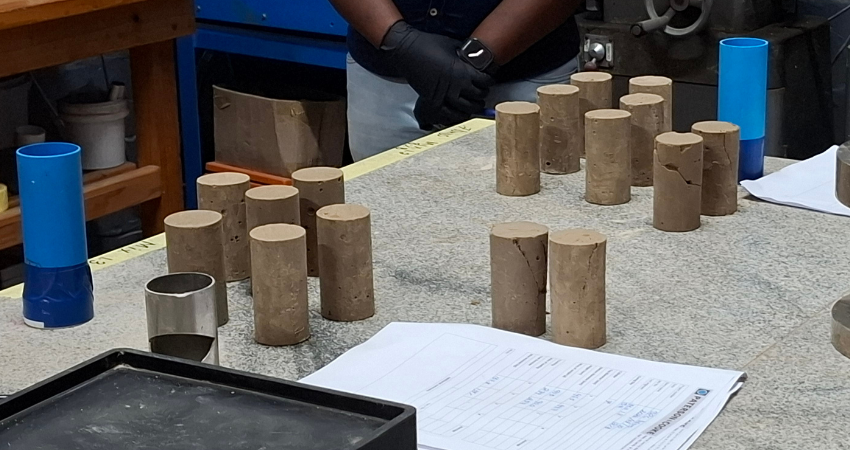
Reliable laboratory testing plays a critical role in the design and optimisation of cemented mine backfill systems such as cemented paste backfill (CPB), cemented hydraulic fill (CHF) and cemented rockfill (CRF). Among the key tests performed is the Uniaxial Compressive Strength (UCS) test, which measures the compressive strength of cured backfill samples under controlled conditions.
The UCS test determines whether cemented mine backfill develops sufficient strength to meet the structural requirements of an underground mine. By testing samples at different curing ages and cement dosages, engineers can evaluate backfill performance, optimise binder consumption, and verify that design strength requirements are achieved. The result is a safer, more cost-effective backfill system that balances operational performance with economic efficiency.
Paterson & Cooke is proud to announce that our Santiago, Chile laboratory has expanded its capabilities by implementing UCS testing for cemented mine backfill. This investment further strengthens our global network of specialist laboratories, which now all offers backfill testing. It enhances our ability to support mining projects in Chile, across South America, and internationally with high-quality laboratory testing and technical expertise.
Why UCS Testing Matters
Cemented mine backfill is a key component of many underground mining operations. It provides ground support, enables the safe extraction of adjacent stopes, and facilitates efficient mine sequencing. Achieving the correct backfill strength is therefore essential.
However, specifying more cement than necessary can significantly increase operating costs, while insufficient strength can compromise stope stability and worker safety. UCS testing provides the data required to strike the right balance.
Optimising Operating Costs
Binder is typically one of the largest operating cost components in a cemented mine backfill system. UCS testing enables engineers to evaluate the relationship between cement dosage, curing time, and compressive strength, allowing the minimum binder content required to achieve the target strength to be identified.
This data-driven approach helps mining operations reduce cement consumption, lower operating expenditure (OPEX), and improve the overall economics of their backfill systems without compromising performance.
Supporting Safe Underground Operations
Backfill strength is fundamental to maintaining stope stability and ensuring safe working conditions underground. By verifying that cemented mine backfill consistently meets the required design strength, UCS testing provides confidence that the backfill will perform as intended throughout the mining cycle.
Reliable laboratory testing also supports quality assurance during project development and operation, helping mines validate backfill recipes and monitor ongoing performance.
Purpose-Built Testing Facilities
Our laboratories have specialised equipment designed to produce accurate, repeatable, and representative test results.
Controlled curing environment
Backfill specimens are cured in a chamber with carefully controlled temperature and humidity. Maintaining consistent curing conditions ensures that laboratory samples can be directly compared and provides reliable strength data for engineering analysis.
Automated compression testing
A modern compression press with automatic data acquisition records the applied load and compressive strength with high accuracy. Automated data capture improves testing efficiency, reduces the potential for manual error, and provides transparent, traceable test results.
UCS Testing at Paterson & Cooke
Local Testing, Global Expertise
While Uniaxial Compressive Strength testing is an established method for evaluating cemented mine backfill, our value lies in combining reliable laboratory testing with specialist engineering expertise.
Clients benefit from responsive local laboratory services backed by decades of international experience in underground backfill systems, laboratory testing, and engineering design. Through our network of laboratories and engineering offices, we are able to support mining projects around the world, delivering consistent testing methodologies, technical expertise, and practical engineering solutions wherever our clients operate.
Whether supporting a feasibility study, optimising an existing cemented mine backfill operation, or validating a new backfill recipe, our global network of laboratories provides reliable, high-quality test work that helps you reduce risk, optimise binder consumption, and achieve safe, dependable backfill performance.

Degree in Engineering, Civil Mining Engineer
Daniel is currently a Project Engineer in Paterson & Cooke Chile’s practice, based in Santiago (PCChile). He has experience in the design of water management systems, tailings, and specialises in backfill system design.