

Maximising Underground Tailings Placement: The Operational Challenge
In the first article in this series, we explored the idea that mine backfill can play a larger role in an operation’s overall tailings management strategy.
However, deciding to put more tailings underground and actually achieving it are two very different things.
A mine may have sufficient tailings available to fill its underground voids. It may have a well-designed paste plant and an established distribution system. Yet the operation can still experience a backfill deficit and struggle to keep pace with the mining cycle.
The reason is that the capacity of a backfill system is not defined by plant throughput alone. It is also determined by how effectively the entire process, from tailings production to underground placement, can operate.
If backfill is to function as an important component of tailings management, then maximising underground placement requires a closer look at utilisation, availability, paste quality and the integration of backfill into the mining cycle.
The backfill deficit
At first glance, the availability of tailings should not be a problem. The processing plant produces tailings continuously. In many underground operations, only a portion of those tailings is theoretically required to fill the mine voids.
Yet some operations still find themselves in a backfill deficit.
The problem lies in the difference between how the mill and the mine operate. The mill produces tailings continuously. Backfilling, however, is intermittent.
A mine may not always have a stope ready to receive fill. Backfilling may be interrupted by curing requirements, shift changes and blasting, stope preparation, barricade construction or changes in the mining schedule.
As a result, the availability of tailings does not automatically translate into successful underground placement. Tailings that bypass a downed backfill plant and sent to surface for storage, can be lost and wasted (if a recovery system is not in place).
When the backfill system cannot keep up with mine production, the operation can develop a backlog of unfilled voids. This can increase the void ratio, affect ground control and, in tightly sequenced operations, delay further mining activity.
This is one of the fundamental challenges in using backfill as part of a tailings management strategy.
There may be enough tailings. There may even be enough underground void space. But the operation still needs to be able to connect the two efficiently.
Why availability and utilisation matter
Advances in design and technology have improved reliability greatly, however pastefill systems are not expected to operate continuously without interruption. Some downtime is an unavoidable part of the process.
Paste requires time to cure. Distribution lines need to be switched between stopes. Barricades need to be constructed. Mining activities need to be coordinated with filling activities.
However, beyond this planned operational downtime, many sites experience additional losses that reduce overall utilisation.
The keynote identified three broad categories of downtime.
Operational constraints
These are activities inherent to the backfill and mining process and can include:
- Cure time
- Pipeline switching between stopes
- Barricade construction
Physical constraints
These can include:
- Mechanical failures
- Underground distribution system issues
- Plugged lines
- Barricade problems
- Maintenance requirements
Procedural and logistical constraints
These can include:
- Extended switching times
- Installation delays
- Labour shortages or delays
- Shift changes
- Blasting
- Pipe changeovers
- Delays in preparing the next location for filling
- No available place to fill
While mechanical failures often receive immediate attention, the procedural and logistical causes of downtime can represent significant opportunities for improvement. A backfill plant cannot achieve its potential if the mine is not ready to receive the fill.

The importance of the “all or nothing” approach
The mismatch between continuous tailings production and intermittent backfill demand creates another important consideration.
The mill continues to produce tailings even when the mine cannot receive backfill. It is thus important to highlight the value of designing pastefill systems with the ability to catch up following periods of reduced availability.
The idea is not that a mine must always place all available tailings underground at every moment. Rather, the system needs sufficient flexibility and capacity to recover when delays occur. If the backfill system is designed only to meet an average demand, periods of downtime can result in a backlog that may be difficult to recover.
Designing and operating the system with sufficient capacity to respond to interruptions can therefore be an important part of maximising long-term tailings diversion.
As a mine manager in Timmins once said “I am way better off with a bigger system that is caught up and waiting on the mining, than the other way around”.
Quantity and quality do not always compete
When placing any tailings underground as backfill, the quality of the fill is paramount. The backfill must always meet the geotechnical requirements of the mine.
Considering backfill strength, there is another opportunity that is particularly relevant to pastefill. Increasing the solids concentration of the fill can potentially provide two benefits.
First, a higher concentration paste can achieve higher strengths due to the improved water:binder ratio.
Second, a higher concentration paste places more tailings underground within the same volume.
This means that quantity and quality do not necessarily need to compete.
By optimising the paste concentration and recipe, it may be possible to achieve the required fill strength with a more efficient use of binder while simultaneously increasing the quantity of tailings permanently placed underground.
Of course, increasing paste concentration is not simply a matter of making the material as dense as possible. The resulting paste must still be capable of being mixed, pumped, transported and placed reliably. The optimum solution depends on the characteristics of the tailings, the required fill performance and the capabilities of the backfill and distribution systems.
But the principle remains important:
The quality of the paste can directly influence the quantity of tailings that can be placed underground.

Backfill capacity is more than plant throughput
If a mine wants to maximise underground tailings placement, increasing the size of the paste plant may not be the first or most effective solution.
The operation first needs to understand what is limiting the existing system.
Is the constraint:
- Paste plant capacity?
- Dewatering performance?
- Underground distribution?
- Mechanical reliability?
- Shortage of equipment redundancy?
- Stope availability?
- Mine scheduling?
- Labour availability?
- Switching and preparation time?
- Fill recipe?
- Or the way the process is managed as a whole?
The answer may involve several of these factors.
The important point is that the practical capacity of a backfill system is determined by the entire operation.
A system with a high theoretical throughput but poor utilisation may place less tailings underground than a smaller, well-managed system that operates reliably and is fully integrated into the mining cycle.
Optimising the whole backfill system
When utilisation is low, it can be tempting to focus on the backfill plant. However, the backfill plant is only one part of the overall process.
The complete system includes:
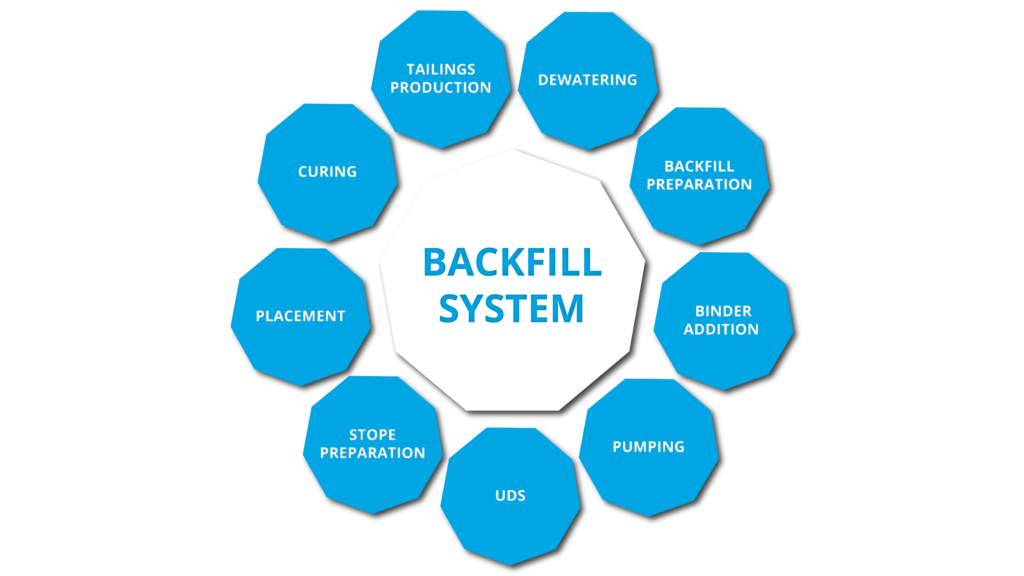
A limitation at any point in this chain can reduce the amount of tailings ultimately diverted underground.
This is why backfill optimisation needs to extend beyond equipment performance.
The mine planning and scheduling process, the availability of prepared stopes, the time required to switch distribution lines and the coordination between different operating teams can all have a significant influence on backfill utilisation.
A good example is Red Lake Gold Mine, where improvements were achieved through changes to organisational structure, planning, scheduling and coordination, as well as optimisation of fill preparation, transportation and distribution (Back Fill Optimization and Innovation—Red Lake Gold Mine's Success Story Nuri Hmidi, Russ Evans, Don MacDonald, Kent Cook, Kris Tietz. Minefill 2017 International Minefill Symposium).
Many of the significant causes of downtime were related to logistics and the coordination of backfill activities rather than the paste itself. The improvements resulted in a reduction in the backlog of unfilled stopes.
From a tailings management perspective, this improvement can also be interpreted as an increase in the mine’s ability to divert tailings from surface storage.
Integrating backfill into the mining cycle
It is clear that backfill cannot be treated as the final step in the mining process. To achieve reliable production, quality and safety, the backfill process needs to be integrated into the mining cycle. This requires a deliberate approach to backfill operations management.
Some elements of such a system include:
- Clear operating procedures
- Quality assurance and quality control practices
- Paste stope design methodology
- Adequate staffing on surface and underground
- Maintenance planning
- Underground distribution management
- Coordination with mine planning and scheduling
These are not additional activities required solely because backfill is being considered as part of tailings management. They are the same initiatives that help improve the performance of the backfill operation itself.
A well-managed backfill system can support the mining cycle, improve the reliability of fill placement and increase the quantity of tailings diverted underground. There is therefore a strong alignment between good backfill operations and effective tailings diversion.
From backfill performance to tailings diversion
As the industry places greater emphasis on integrating backfill and tailings management, backfill performance takes on an additional dimension.
Every hour of unnecessary downtime can represent more than lost backfill production. It can also represent tailings that could not be diverted underground. Every improvement in stope availability, distribution efficiency or operational coordination can therefore contribute to both mining performance and tailings management objectives.
The challenge is to view the backfill system as a complete process rather than a standalone plant.
A reliable system that produces consistent, high-quality fill and is well integrated into the mining cycle is better positioned to maximise the amount of tailings permanently placed underground.
This creates an important foundation for the next question.
If mines can improve the way they operate existing backfill systems, what becomes possible when tailings management and backfill are integrated from the earliest stages of mine design?
In Part 3, we explore some of the possibilities for the future. From dual-purpose tailings plants and higher-density fill to the use of alternative underground voids for tailings management.
About this series
Backfill – The Other Tailings Storage Facility explores the evolving relationship between mine backfill and tailings management, based on Maureen McGuinness’s keynote address at Minefill 2026.
Previously in the series:
Part 1: The Future of Backfill – Promoting the Role of Backfill in Tailings Management
Next in the series:
Part 3: The Future of Backfill – Designing Mines for Integrated Tailings Management

MEng (Mining), BEng (Metallurgical)
Maureen McGuinness is a Director in Paterson & Cooke Canada Inc. in the Sudbury, Ontario, practice. She has more than 30 years of experience working in mining and milling, and specifically in paste backfill design and operations.
Her expertise includes backfill operation, backfill management planning, dry tailings plant-feed operations, hydraulic modelling of distribution systems, startup and commissioning of backfill operations and training of staff. Maureen completed her Masters in pastefill underground distribution system wear.