


Artificial Intelligence (AI) is no longer a futuristic concept—it’s here, transforming the way we work across industries (Pearson, 2015; Cowen, 2020; Brynjolfsson & McAfee, 2016; Suzman, 2020; Shell, 2018).
In structural design, AI is proving to be a game-changer, enhancing efficiency, accuracy, and innovation (Leonhard, 2017; Daugherty & Wilson, 2016).
But how exactly is AI shaping the future of structural engineering?
Understanding AI in Structural Design
Firstly, it's important to demystify what Artificial Intelligence means and what it can bring us. We can't summarise such a broad field of knowledge here, but we recommend some reading (Oliveira, 2019; Debney, 2020; Ertel, 2017).
We would point out that much of the work to raise awareness has been done through the widespread use of tools such as ChatGPT or Copilot, which have (unintentionally) helped to demystify the term 'Intelligence'. In reality, it's about generation, which follows training and responds to a request.
In other words, it is something that will remind designers of calculation models. From the simplest to the most complex, calculation models and AI techniques give us answers whose quality cannot surpass the excellence of the data input and is limited by the relevance of the 'question' posed.
Key AI Applications in Structural Engineering
AI is making waves in structural design in several key areas:
Determining Material Properties and Structural Elements
By analysing experimental data, AI models can accurately predict the properties of structural materials. Predicting concrete properties was a precursor and continues to be very popular. It is also possible to establish AI models based on experimental information or derived from numerical models, making it possible to estimate structural elements' resistance capacities or failure modes.
Enhancing Structural Modelling & Analysis
Although we don’t yet have fully AI-driven structural modelling and analysis software, AI is already improving finite element analysis (FEA) tools. It helps refine mesh generation and optimise calculation parameters, leading to more accurate results and better computational efficiency.
AI-Powered Design & Optimisation
AI-assisted design tools are redefining how engineers approach projects. From generating parametric designs to optimising structural configurations, AI significantly reduces manual effort to the point where we can talk about design tasks done with little or no human intervention. However, while the term "optimisation" is often used, it is misleading since achieving the mathematical optimality criteria required for topological optimisation in this way is impossible.
Beyond Design: AI’s Expanding Role in Structural Engineering
The impact of AI extends beyond just design and analysis. Here are some other interesting applications:
AI in Building Information Modelling (BIM)
Leading BIM software providers are integrating AI to streamline workflows, such as detecting and resolving geometric clashes between structural elements.
Automated Drafting & Image Recognition
Advances in image recognition—particularly through Convolutional Neural Networks (CNNs)—are making automatic drafting more efficient. AI can interpret manual sketches and convert them into digital drawings with precision.
Structural Health Monitoring & Predictive Maintenance
Perhaps the most significant AI application today in structural engineering is in real-time monitoring and predictive maintenance. AI processes continuous data streams, identifies structural wear and damage, and recommends corrective actions. This proactive approach minimises risks and extends the lifespan of structures.
AI in Action: Predicting Buckling Loads in Steel Beams
One example of AI’s effectiveness is in predicting the critical elastic buckling load of cellular steel beams. Traditionally, this calculation required extensive parametric analyses using FEA models. However, by training an artificial neural network on these results, researchers developed a formula that predicts buckling loads with remarkable accuracy—within 0.4% error (Abambres et al., 2018). This breakthrough makes complex calculations more accessible and practical for everyday structural design applications.
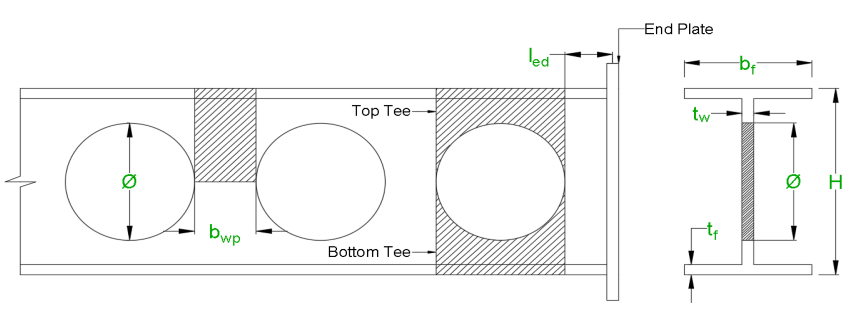
Figure 1 – Geometry of the hollow beams considered and model parameters 11.
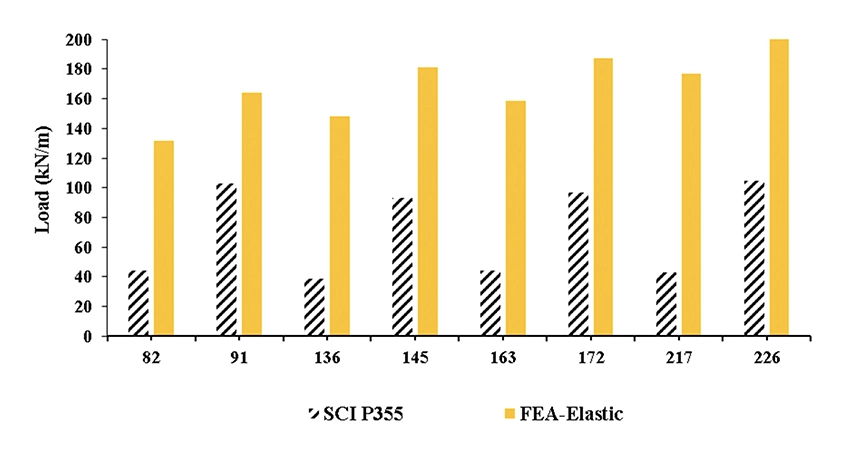
Figure 2 – Comparison between the values obtained for training and as a result of the AI model (FEA-Elastic) and the design values obtained from the formulations generally used in the project (from the British publication SCI P355). It can be seen that the values now available, as well as being more accurate, are much more favourable11.
Looking Ahead: What’s Next for AI in Structural Engineering?
AI is evolving rapidly, and its role in structural design will only grow. While AI-driven software can enhance decision-making, human expertise remains crucial. The future will likely see even deeper AI integration, with smarter design tools, improved predictive analytics, and further automation of routine engineering tasks.
Final Thoughts
AI is not here to replace engineers—it’s here to empower them. By embracing AI-driven tools and methodologies, structural engineers can unlock new levels of productivity in their designs. The possibilities are endless.
View our Specialised Civil & Structural Engineering services.
References
- Pearson, T. The End of Jobs: Money, Meaning and Freedom Without. (2015).
- Cowen, T. Average is Over. (2020).
- Brynjolfsson, E. & McAfee, A. The Second Machine Age: Work, Progress, and Prosperity in a Time of Brilliant Technologies. (2016).
- Suzman, J. Work: A History of How We Spend Our Time. (2020).
- Shell, E. R. The Job: Work and Its Future in a Time of Radical Change. (2018).
- Leonhard, G. Technology vs. Humanity. (2017).
- Daugherty, P. R. & Wilson, H. J. Human + Machine: Reimagining Work in the Age of AI. Harvard Business Review Press (2016).
- Oliveira, A. Inteligência artificial. Fundação Francisco Manuel dos Santos (2019).
- Debney, P. Computational Engineering. (2020).
- Ertel, W. Introduction to Artificial Intelligence. (Undergraduate Topics in Computer Science) (2017).
- Abambres, M., Rajana, K., Tsavdaridis, K. & Ribeiro, T. Neural Network-Based Formula for the Buckling Load Prediction of I-Section Cellular Steel Beams. Computers (2018)

BEng, MEng, PhD (Civil), MEng (Structural), MEng (Mechanical), CEng
Tiago joined Paterson & Cooke in 2024 after working with the company since 2020 and having previous experience in structures for the mining industry of more than 15 years.
He has worked on a wide variety of international projects, including the design and detailing of steel, reinforced and prestressed concrete, timber, aluminium, and masonry structures, bridges, scaffolding systems, construction equipment, cranes, offshore structures, cable and membrane structures, geotechnical studies and foundation design, retrofitting, strengthening, technical support, field supervision and forensic engineering. Tiago’s scope of work ranges from conceptual work through to detailed design and construction.
Tiago is a member of the Portuguese Association for Artificial Intelligence.