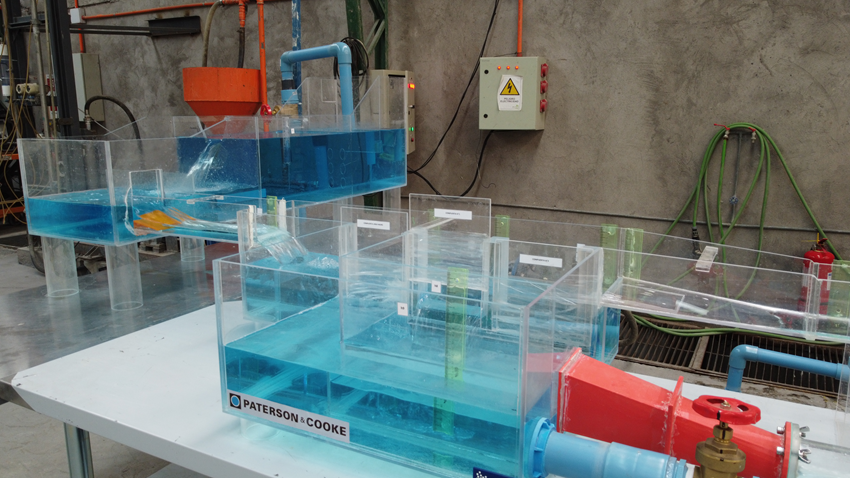

Paterson & Cooke scale model of tailings distribution box

In mining, where massive volumes of tailings slurry need to be managed safely and efficiently, even the smallest design detail can make a big difference. One such detail—often overlooked but critically important—is the tailings distribution box.

At first glance, it might seem like a simple piece of equipment. But when it comes to distributing slurry evenly across multiple pipelines (with varying flow and pressure requirements), the physics gets complicated. That’s where scale modelling comes in.


The Challenge: Making Sure Every Outlet Gets Its Fair Share

In tailings transport systems, a distribution box sits between the thickener and a network of pipelines. Its job? Divide slurry flow evenly among several outlets—without favouring one over the others.

Uneven flow can lead to major issues:

  • Overloading of certain pipelines.
  • Erosion or wear in specific areas.
  • Poor deposition in tailings ponds.
  • Failure to meet dam fill targets in the desired area.

In a study for a major copper mine, our Paterson & Cooke Chile team wanted to ensure even flow distribution in a newly designed tailings distribution box—before building it full-scale. The solution? Build a physical model at reduced size and simulate real-world behaviour in the lab.

Why Go Small to Think Big?

Using a 1:20 scale model, our researchers tested how the slurry would behave in real conditions—except instead of using actual tailings slurry (which is heavy, abrasive, and messy), they used water. By matching the Froude number—a ratio that captures the balance between gravity and inertia—the water flow is used to simulate large scale turbulent slurry flow.

This approach is called Froude scaling, and it’s a dimensionless method for modelling free-surface flows like those in slurry systems.


The Design: Symmetry and Flow Science

The prototype distribution box featured:

  • A central inlet pipe.
  • Multiple outlets arranged asymmetrically.
  • Flow straighteners and transition sections to smooth things out

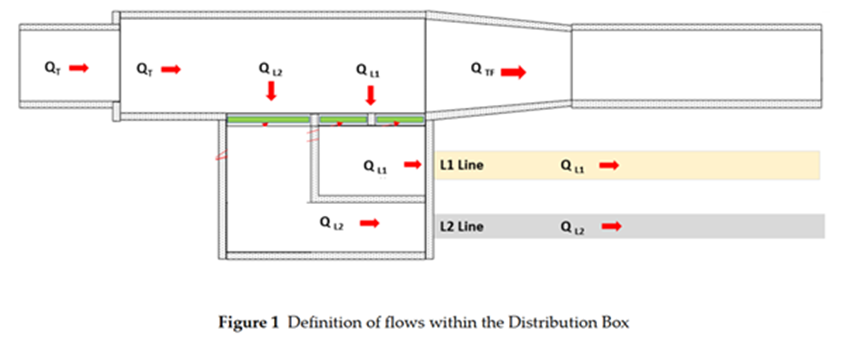
The tailings distribution box allowed the outlets to operate in different flow regimes and included spillways to carry out passive flow distribution.

Flows within distribution box

Every part of the design was scaled to maintain geometric similarity, a requirement when translating lab results to full-scale performance.

The design of the new Distribution Box included theoretical calculations and comprehensive CFD analysis to be able to properly validate the complex system.


What the Model Revealed

Testing the model in action was eye-opening. Here’s what they discovered:

  • The scale model validated the theoretical design and its results.
  • Flow imbalance occurred when the inlet velocity or alignment was off.
  • Small changes to the geometry—like adjusting the inlet angle—had a big impact.
  • The scale model allows you to adjust some variables and see their impact quickly.
  • With some tweaks, they achieved remarkably uniform flow across all outlets.

The CFD results showed no overtopping or other unfavourable outcomes during any of the scenarios investigated. Simulations confirmed the operability of the system and were instrumental in allowing the project to proceed to the construction phase of design.

CFD for distribution box

This kind of insight is nearly impossible to get from simulations alone. Both the CFD analysis and the hands-on testing allowed the team to identify problems early and refine the design before construction.


Why This Matters for Slurry Systems

For engineers working in slurry transport or tailings management, this study offers a valuable takeaway: scale modelling works—and it can save time, money, and risk.

This gives engineers a reliable way to validate performance and optimise results in a controlled environment.


Final Thoughts: Don’t Skip the Small Stuff

Tailings distribution boxes are often overlooked  but it is critical in slurry transport systems to evenly distribute flow. Getting it right means fewer shutdowns, safer operations, and longer equipment life.

Thanks to a scaled-down model and insightful fluid dynamics, the project team turned a simple box into a smart solution—and proved that sometimes, thinking small is the best way to go big.


Find out more about our Slurry Pipeline Services and Tailings & Mine Waste Systems.