

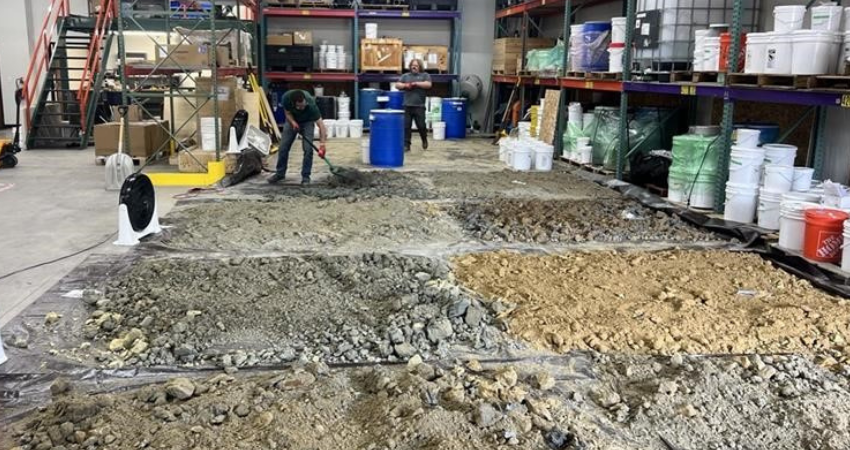
In mineral processing testing, good data starts with good sampling. It sounds simple, but it is one of the most important — and often underestimated — parts of any mineral processing program. No matter how advanced the equipment or how detailed the test work is, the results are only as reliable as the sample being tested.
That becomes even more important as projects move into increasingly complex ore bodies, finer mineralisation, and lower grades. Variability in mineral distribution, particle size, hardness, or liberation characteristics can significantly impact process design and performance. A laboratory can generate precise results, but if the sample itself is not representative, the conclusions drawn from the data may still be flawed.
Industry-wide, there is growing recognition that “the quality and type of samples used are as important as the test work itself” and that representative sampling forms the foundation of meaningful metallurgical programs.
Building the Right Laboratory Approach
At Paterson & Cooke’s global laboratory network, we view sampling and sample preparation as the foundation of every successful test program.
The recently expanded laboratory in Denver, Colorado was built with that in mind. Beyond increasing capacity, the goal was to build a laboratory capable of delivering high-quality testing while maintaining strong control over sample handling, preparation, and QA/QC procedures throughout the process.
That means focusing on the details that matter, including:
- Proper homogenisation procedures
- Representative sample splitting
- Careful handling of coarse and fine fractions
- Consistent QA/QC practices
- Preparation procedures tailored to the ore type and mineralogy
Different ore types require different approaches, and there is no substitute for experience when it comes to understanding how to minimise variability and maintain sample integrity.

Experience Makes the Difference
With a team that has spent years building and managing mineral processing laboratories and process plants, we have seen firsthand how sampling issues can quietly become the source of inconsistent or misleading metallurgical results. In many cases, the laboratory work itself may be performed very well, but if the sample entering the program is not representative, the conclusions drawn from the data can still be flawed.
Over time, one thing becomes very clear: successful metallurgical programs are built on strong fundamentals.
Those fundamentals include:
- Experienced technical personnel
- Disciplined sample handling procedures
- Well-maintained preparation equipment
- Strong communication between laboratory and engineering teams
- A consistent focus on data quality and representativity
These are often the factors that make the biggest difference in reducing technical risk and generating reliable metallurgical data.
Supporting Better Process Development
That same philosophy has carried into the growth of Paterson & Cooke’s laboratory capabilities. The team combines practical operational knowledge with metallurgical testing expertise, allowing programs to be approached with a strong understanding of how laboratory results ultimately translate to real plant performance.
Paterson & Cooke supports a wide range of metallurgical investigations, including:
- Sample preparation needs
- Flotation optimisation
- Leach optimisation studies
- Dewatering and solid-liquid separation testing
- Pilot-scale support programs
- Broader process development programs
In each case, the focus remains the same: generating meaningful, technically defensible data that clients can rely on when making important engineering and operational decisions.
Getting the Fundamentals Right
As projects continue to become more technically demanding, the importance of getting the fundamentals right only increases. At Paterson & Cooke, that starts with representative sampling, experienced people, and a commitment to doing laboratory testing properly from the very beginning.
Reach out to our experts now to start discussing your project needs.
- Kathy Adams, PEng, PMP Mineral Processing Manager, USA (kathy.adams@patersoncooke.com)
- Nick Gow, PhD, QP – Senior Laboratory Manager / Senior Study Lead, USA (nick.gow@patersoncooke.com)
- James Wickens, Pr Eng – Metallurgical Test Facility Manager, South Africa (james.wickens@patersoncooke.com)

PhD Metallurgical Engineering/Chemistry, BS Chemistry, MS Metallurgical Engineering, BS Metallurgical and Materials Engineering
Nick joined the Paterson & Cooke team in 2022 and is currently a senior study manager based in our Denver office. He is a diverse mineral processing engineer with fifteen years of experience based in early-stage project metallurgical development and late-stage/brownfield process optimization.
Nick’s is also certified as a MMSA Qualified Professional for Mineral Processing, Professional Engineer, CN Code Auditor, Associate Editor for the MME Journal, ABET Program Evaluator, and Research Associate Professor at the Colorado School of Mines.