


Pipelines are often thought of as straightforward pieces of infrastructure—steel tubes running across landscapes, quietly carrying fluids and slurries to where they are needed. Yet behind this apparent simplicity lies a highly engineered system that demands careful operation, regular maintenance, and robust control strategies.
Nowhere is this more evident than in the mining industry, where long-distance slurry pipelines play a crucial role in transporting concentrates like copper and iron.
The Global Pipeline Network: A Mature Industry to Learn From
Across the world, pipelines stretch more than 3.5 million kilometers. Most of these are dedicated to the oil and gas sector, but mining has increasingly adopted pipeline transport for its efficiency, safety, and environmental benefits.
The world’s first coal slurry pipeline, the Ohio Coal Slurry Pipeline, was built in the United States in 1957. By the late 1960s and early 1970s, the approach had expanded into mining: first for iron concentrate in Tasmania, then for copper concentrate in Bougainville. Since then, slurry pipelines have become a trusted method of transporting minerals over hundreds of kilometers.
What makes this history particularly valuable is the maturity of pipeline integrity practices. Oil and gas operators have decades of experience managing aging pipelines—experience that can be directly transferred to the mining industry as it faces similar challenges of wear, corrosion, and reliability.
What Defines a Long-Distance Pipeline?
Not all pipelines are created equal. Short sections of piping within a plant have very different demands from a 300 km slurry pipeline crossing mountains, rivers, and valleys. Long-distance pipelines are characterised by:
- Advanced control systems: Fully automated sequences, redundancy in communication networks, and continuous monitoring are essential.
- Leak detection systems: Early warning is critical when operating across sensitive environments.
- Buried construction: To protect against external damage and to avoid bisecting valuable land above ground, most pipelines are buried and protected with coatings and cathodic protection.
- Longevity-focused equipment: Pumps, valves, and linings are chosen with lifespans that often exceed those of conventional plant pipelines.
- Operation planning: The cost of downtime is significant, meaning proactive maintenance and scheduling are built into operational strategies.
From headwater stations with agitated ponds to choke (dissipation) stations and terminal thickening facilities, every component of a long-distance slurry pipeline must be carefully engineered for resilience.

The Integrity Challenge: Keeping Pipelines Safe and Reliable
Pipeline integrity is defined by standards such as ASME B31.4, which emphasise a pipeline’s ability to withstand anticipated loads with a safety margin. But integrity is more than design—it’s about continuous management.
The risks are varied:
- Wear and erosion from abrasive slurries
- Blockages, either from rheological behaviour of the slurry or from damage to internal linings
- Geohazards, including landslides or seismic events
- Material fatigue leading to cracks or failures
Traditional external inspection is often difficult because pipelines are buried. Excavation is costly and disruptive. This is where internal inspection—pigging—becomes invaluable.
Pigging: Seeing Inside the Pipeline
The concept of pigging dates back to the late 1800s, when simple devices were pushed through crude oil pipelines to clean deposits. Today’s pigs are highly advanced. They travel within the slurry or fluid flow, propelled by pressure differentials, and provide vital insights into the health of the pipeline.
There are three main categories of inspection pigs:
- Magnetic Flux Leakage (MFL) pigs: Detect metal loss and corrosion
- Ultrasonic (UT) pigs: Measure wall thickness
- Geometric pigs: Detect dents, ovality, and deformation
Modern “intelligent pigs” combine these functions, recording data that can be georeferenced using GPS. This means operators don’t just know what condition their pipeline is in—they know precisely where an anomaly lies.
Importantly, pipelines need to be designed with launching and receiving stations to enable pigging. This foresight during design can save operators significant costs and downtime later.
A Real-World Case Study: Predicting Pipeline Life
At Paterson & Cooke, we’ve worked with clients to apply these tools in practice. In one project, pipeline thickness data was collected during pigging campaigns in 2007, 2011, and 2014. By analysing the progression of wear, engineers were able to calculate:
- Baseline condition at commissioning
- Wear rates over time, based on repeated measurements
- Remaining service life, by converting thickness data into allowable operating pressures (Maximum Allowable Operating Head)
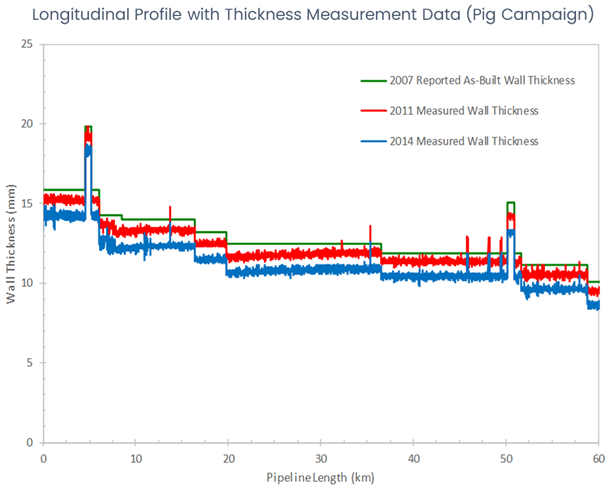
The outcome was a reliable prediction of how long the pipeline could continue operating safely. A follow-up campaign in 2018 confirmed the forecasts. Instead of reacting to failures, the operator had a clear, data-driven maintenance plan that reduced risk, avoided costly downtime, and maximized the asset’s value.
Planning for the Future: Integrating Operation and Control
A key lesson is that pipeline integrity must be integrated into long-term operational planning. This means:
- Designing for inspection: Pigging stations must be part of the system layout.
- Capturing and preserving data: As-built drawings and inspection histories are essential. Without them, operators should invest in an initial inspection campaign to establish a baseline.
- Implementing integrity plans: Regular inspection, preventive maintenance, and long-term wear monitoring should be non-negotiable.
- Aligning with production goals: If production is expected to increase, or if the pipeline’s lifespan must be extended, these changes need to be factored into control strategies and maintenance schedules.
Ultimately, a control philosophy—developed alongside other engineering disciplines—ensures that the pipeline operates not just reliably, but strategically.
Conclusion: Treating Pipelines as Strategic Assets
Long-distance slurry pipelines are much more than hidden infrastructure. They are critical assets whose safe and reliable operation underpins the productivity of entire mining operations. By designing a safe and reliable pipeline system, adopting modern inspection technologies, and embedding integrity management into planning, mining companies can safeguard their investments and operate with confidence.
Paterson & Cooke has decades of global experience executing long-distance pipeline projects, from pre-feasibility to detailed engineering design, construction assistance, and commissioning. Find out more.

Leonardo joined Paterson & Cooke in 2018 and has many years of experience with emphasis on the design of transport systems for mining pulp and water.
He also has experience leading hydraulic teams and performing tasks of hydraulic design of tailings transport system, CFD modelling, scale modelling of tailings discharge systems, water transport system, selection of pumping equipment, specifications, and economic technical analysis in prefeasibility, feasibility and detail projects.